

When Feeling Down, Ask Yourself Why at Least 5 Times
1-Minute Engineering on Problem Solving — Edition 20


Every one of us, at some point in our journey, hits a plateau.
A point of no more growth. A place of stagnation. A spot where progress has stalled. It happened to me before, and I might have just reached yet another one.
Imagine you are climbing a mountain, and your goal is to reach the peak. Your focus is sharp, and your mind and body work together to get you there. You don’t give up when it gets hard and are consistent with your efforts. Eventually, you reach the top.
Now, you can take a big breath and enjoy the view. You deserve it!
Shortly after, you realise that there’s a higher peak you couldn’t have seen from the ground. Sh*t, you didn’t reach the top yet; you only hit a plateau.

You have no clue what to do now. The mountains before you are steeper and higher, and you lack both the skill set and the appropriate tools.
It’s a place of frustration, discouragement, and feeling stuck. Sounds familiar?
The last time I reached a plateau, a friend told me she thinks plateaus are a necessary evil in our growth. You can’t have one without the other.
It offers us the opportunity and space to take a break, recover from the previous efforts, celebrate the progress we made, enjoy the views, and realign with our core values before continuing our journey.
Most importantly, it’s the perfect time to realign with why you are doing what you are doing and what you are doing to get there.

This might be one of the most dramatic introductions I have ever written, only to segue to a tool I’m currently using to recalibrate my internal system of values. 🙃
But let’s face it: You don’t have to reach a personality meltdown to feel stuck, frustrated, or discouraged. Even a bottleneck in the process might derail you from being on track, or a defect in your app might keep you awake at night because you don’t understand what is causing it.
Let me introduce you to the 5 Whys.
The 5 Whys
The 5 Whys is a problem-solving technique that helps you identify the root cause of an issue by repeatedly asking “why?”. Here’s an example in the context of a web application.
Problem: A web application crashes frequently during peak hours.
Why does the web application crash during peak hours?
Because the database response time increases significantly.Why does the database response time increase?
Because the number of queries being processed is too high.
Why are there too many queries being processed?
Because each user request triggers multiple redundant database queries.
Why does each user request trigger multiple redundant queries?
Because the application does not implement proper caching.
Why does the application lack proper caching?
Because caching was not considered in the initial design.
Root Cause: The application was not designed with caching in mind, leading to excessive database queries and performance issues under load.
Now, you can work on a solution that addresses the root cause instead of only fixing a symptom.
Ask Yourself Why at Least 5 Times
I’ve used this tool before to debug issues that annoyed our users and made us lose our minds. Debugging is a great place to ask ourselves the five whys. It’s even compatible with the Rubber Duck debugging technique. You can repeatedly ask the Rubber Duck why the app is crashing; it won’t mind.
I also used this technique to improve the development process by identifying bottlenecks in my team's processes. In one project, the pull request review time reached days, unnecessarily increasing the cycle time of our tickets. It turned out that having a dedicated lane for code review was what caused the delays.
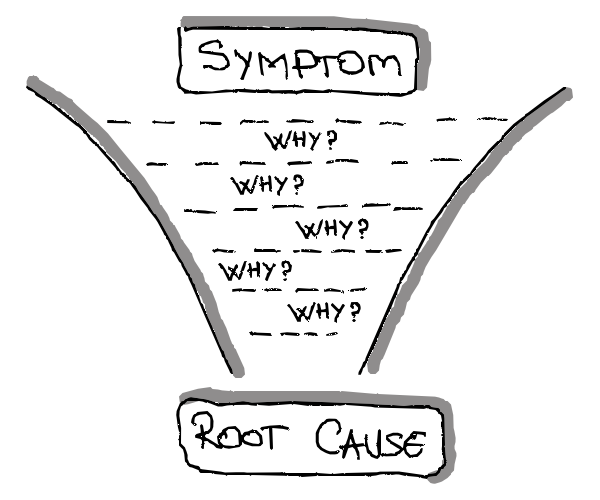
The 5 Whys helps you narrow down the list of possible issues until you reach the root cause. Each layer of symptoms that you peel off gets you closer to the core issue.
You can think of it as a funnel—you pour the symptoms at the top and get a sense of what really happened at the bottom.
However, this tool can be used in a variety of other scenarios besides root cause analysis, such as strategic planning, personal and professional development, conflict resolution, or team dynamics.
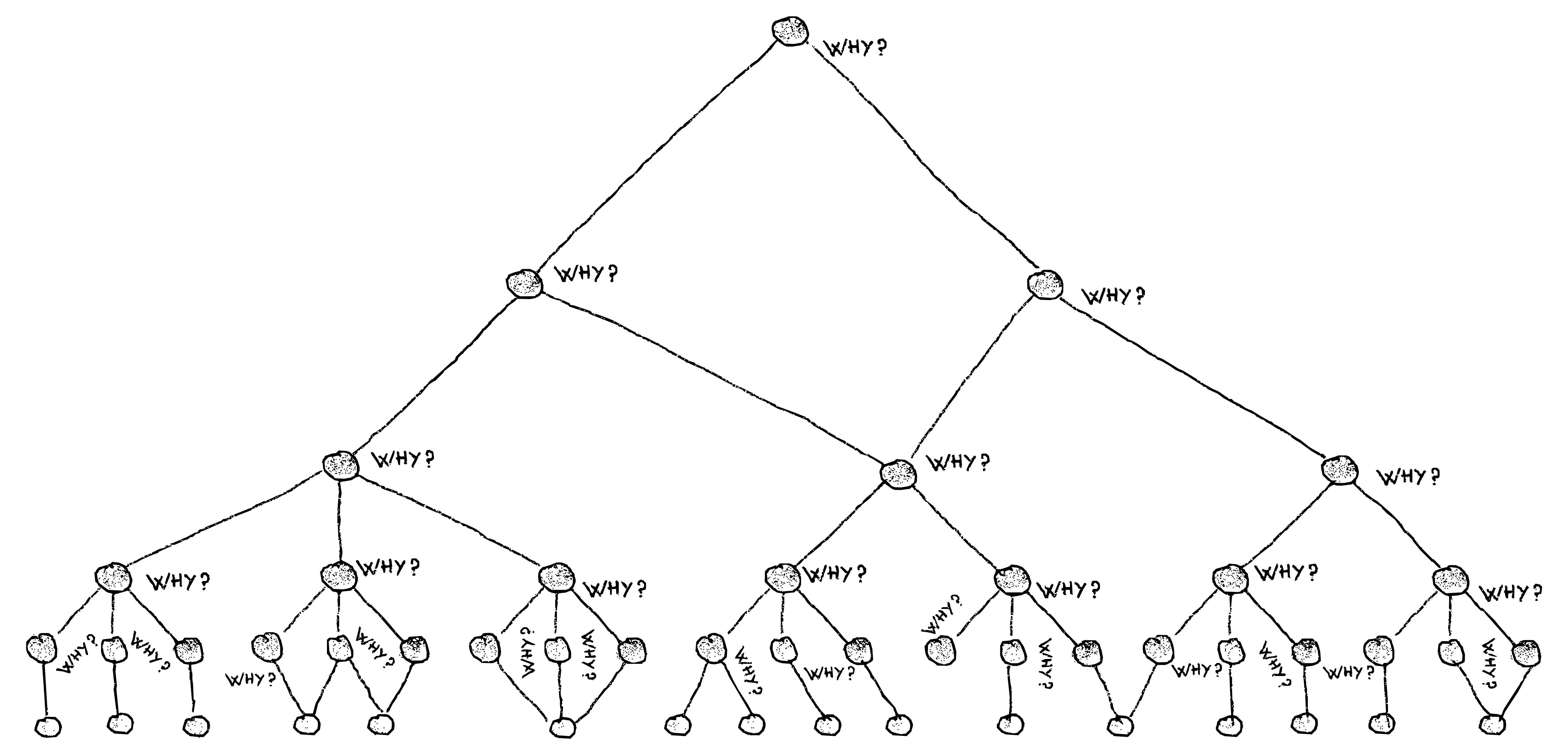
In my case, I decided to ask myself the five whys to help me identify why the experience of writing this newsletter feels like a roller coaster. The results were not what I had expected.
Instead of constructing a funnel to help me narrow down the possible root cause, I’ve built a tree in which each “Why?” I asked, sprouted more than one branch.
Personal Conclusions
I hoped to find a single reason to write this newsletter that would fuel my motivation to keep going. Instead, I’ve got a bunch of reasons.
First of all, I realised I have to be more than honest with myself. There isn’t one single reason why I do this, so I have to embrace them.
Although I don’t focus on the number of subscribers, I want to grow a list of like-minded readers whose interests intersect with mine. This is an asset worth building.
I want to become more articulate in my speech and in the way I think, and I know writing is the stepping stone to this goal.
Sharing my experience, documenting my know-how, and helping others grow are crucial for living by my contribution inner value.
Building a new stream of income by enabling paid subscriptions is neither evil nor egocentric. Money is a catalyst, an enabler for all the above.
I also want to do all these with sustainability in mind since I don’t want to degrade my health, and I want to spend quality time with my family and friends.
Ultimately, I have to be grateful for what I have and continue working for what I want. It’s not always easy. Sometimes, I feel discouraged, and other times, I feel stuck, but that's okay.
It’s a process I’m learning to enjoy.
—Alex